

In executive meetings, certain HR compliance topics dominate the conversation. Payroll taxes command attention because errors show up on financial statements. OSHA violations make headlines when accidents occur. Employee handbooks land on legal desks during litigation.
Yet, labor law posters rarely generate this level of executive concern. They hang in break rooms and near time clocks, often unnoticed unless someone specifically looks for them. As Lighthouse Research & Advisory noted in a recent report about what employers want from HR solutions and services providers, labor law posters are “easy to assume they are current. Easy to forget they carry legal weight.”
As a refresher, labor law poster compliance is the legal (and legally enforced) requirement for employers to display mandatory federal, state, and local (i.e., city and county) notices. Notices such as FLSA minimum wage, OSHA safety rules, and anti-discrimination laws must be displayed in conspicuous workplace locations such as break-out areas, lunchrooms, etc. as well as digitally for remote employees. Failure to maintain and display both current and readable posters (note: there are also size requirements) can often lead to significant government fines for each and every violation. Such fines include:
- up to $26,262 for the Employee Polygraph Protection Act
- up to $16,550 for OSHA
- up to $698 per violation for the Equal Employment Opportunity Commission
- up to $216 per violation regarding the FMLA (Family and Medical Leave Act).
My take on labor law compliance: The most material business risks and opportunities are often ‘invisible’, such as labor law compliance. It’s the ‘invisible’ risks that can cause the most damage to the health and reputation of an employer — because organizations typically aren’t prepared for them until they sneak up on them. So let’s dive more deeply into this very informative report.
Key research findings from Lighthouse Research & Advisory
500+ HR and Business leaders were asked recently by this leading research and advisory firm focused on HR and workforce issues , about what they want and need from their HR solutions and services providers. Sponsored by HR Compliance services firm Poster Elite, this was entirely independently conducted research.
Some of the findings that stood out to me:
- 73% of employers consider up-to-date labor law posters essential — surprisingly, the highest of any compliance category cited, followed by payroll tax reporting in a close second, not unexpectedly as a major compliance concern. My take: The frequency of potential changes year-round, combined with multiple governing authorities makes labor law compliance not easily trackable by employers. So, having up-to-date labor posters is critical to ensure employers stay HR compliant in all key areas.
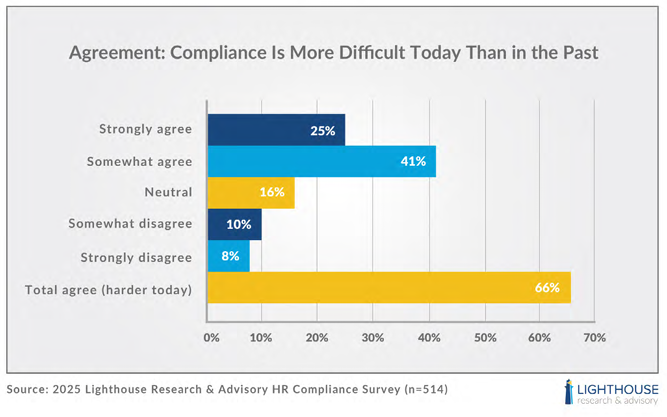
- Hundreds of employment law changes occurred last year alone, ranging from minimum wage updates, paid leave laws, workplace safety requirements and everything in between. These changes happen not only at the Federal and State level, but also within local city and county jurisdictions. My take: Keeping up with labor law requirements has become (and remains) a significant operational challenge, and this is even as 91% of employers actively monitor compliance requirements (according to the study).
What you might not know about poster compliance
So, labor law posters are essential for employers to effectively manage operating risks, but really, how difficult is this particular compliance arena to manage?
As someone who has spent 15 years of my 4-decade career in HR/HCM/HR Technology in VP-HR roles in major financial services firms reporting to CHRO’s, I was genuinely surprised about the answers to frequently asked questions on the U.S. Department of Labor’s Q&A web site. Here are three examples which explain why labor law poster compliance – and its inherent operating risks – has catapulted to the top HR compliance concern in the Lighthouse study:
- If a state law provides greater protection (e.g., has a higher minimum wage than the federal minimum wage), the employer still must post the federal Fair Labor Standards Act (FLSA)/Minimum Wage poster. This is likely because the federal poster also provides information regarding federal regulations on child labor and overtime rules in addition to the federal minimum wage.
- How an employee is paid, even if in commission pay only, is not relevant to whether employers must post the Fair Labor Standards Act (FLSA)/Minimum Wage poster.
- Where an employer has employees reporting directly to work in several different buildings, the employer must post all required federal posters in each and every building, even if the buildings are in the same general vicinity, such as in an industrial park or on a campus.
How to keep up with changing labor law regulations
Since it’s essential and often complex to manage, how can employers reliably and efficiently ensure labor law compliance, including as it relates to these visible posters? Well, for starters, give priority to being up-to-date on the most frequently updated areas of HR compliance.
For example, did you know that nineteen states raised their minimum wage in 2026 , with several others having scheduled mid-year or late-year increases? The federal minimum wage remains at $7.25 per hour. Recent 2026 state wage updates include:
- Alaska – raised to $13.00 on January 1, 2026 and further increased to $14.00 on July 1, 2026
- California – raised to $16.90 hourly on January 1, 2026
- Florida – set to increase to $15.00 per hour on September 30, 2026, moving up from $14.00
- Hawaii – went to $16.00 per hour on January 1, 2026
- Missouri & Nebraska – both climbing to $15.00 per hour at the start of 2026
- New York – increased its minimum wage to $17.00 for NYC and surrounding counties, and $16.00 for the rest of the state.
Given this fluidity in the U.S.’s HR pay compliance landscape alone, I’d make these two recommendations to employers:
- Check for updates on a predictable schedule, but don’t be tied to what has previously occurred relative to poster compliance. That is not a risk-free approach by any means.
- Ensure you are working with an HR compliance expert or services firm that is very much on top of which government body has precedence when there are differences between Federal, State and Local ‘legs and regs’ as we used to say when I worked in HR. ; and bear in mind this is not only non-intuitive, but there are also instances in certain states where they legislatively take precedence in this area and also have won in the courts that the Federal level cannot override their employer-related mandates concerning workforces in their state. Sound like a lot of work? It is, so what’s the return on investment on staying compliant besides avoiding fines and litigation?
Sound like a lot of work to keep up with labor law compliance? It is, so what’s the return on investment on staying compliant besides avoiding fines and litigation?
The case for compliance
When businesses treat compliance as an afterthought—whether by failing to keep postings updated, displaying them inconsistently, or neglecting digital posting requirements for remote workers— they send an implicit message that labor rights are not a priority. Employees notice these signals. If an employer disregards something as fundamental as informing workers of their rights, employees may wonder: What else is being overlooked?
This perception can damage trust and credibility, weakening HR-driven employee engagement efforts. As I’ve been saying for years in my industry talks, almost everyone is aware that engagement and productivity go hand-in-hand but most don’t realize that small upticks in employee productivity can translate into very sizable business benefits.
It’s simple math. If revenue per employee is $100k for example (a long-standing productivity related metric used ) and it improves by a mere 4%, revenue in this example would grow from $10,000 k to $104,000. Where this gets dramatic is when the additional $4,000 is multiplied by let’s say a 5,000-employee organization. That would then yield a business benefit of $20 million dollars!
So, HR compliance isn’t just about risk or fine avoidance; compliance is also a factor in employee engagement, productivity, satisfaction and eventually retention. When seeking “employer of choice” status, employers can’t risk the hits to trust and reputation that result from being fined and publicly shamed for compliance violations, many of which relate to employee safety, health and well-being. Furthermore, in today’s business climate, compliance violations could also hinder an employer’s ability to recruit top talent.
What’s next for compliance
In my next blog post, I’ll explore how employers can find solutions for labor law poster compliance and what to look for.
Written By
